
Question 3 creates an All-Party Primary in Massachusetts.
Every registered voter receives the same primary ballot. This ballot includes every candidate from every party. Every voter gets a voice in every race, and at every stage of the election. The top two vote-getters advance to the general election. Because Massachusetts ranks last in the nation in electoral competitiveness, uncompetitive races allow politicians to ignore voters – and drag their feet on delivering results.
Question 3 increases competition, and fusion voting is one reason for this. Fusion voting means that minor parties are included in primary ballots, along with major parties, and can showcase their support. Those parties avoid becoming spoilers in the general election.
What Fusion Voting Is
Fusion voting allows more than one party or organization to visibly support the same candidate on the ballot. Each candidate appears once on the ballot. Each candidate appears on a single line. The ballot lists each candidate’s party registration. The ballot also prints each endorsement next to the candidate’s name. Each voter casts one vote for one candidate. New York, Connecticut, Oregon, and Vermont all use forms of fusion voting.
How Fusion Works Under All-Party Primaries in Massachusetts
Massachusetts’s Question 3 replaces separate partisan state primaries with one all-party primary. This means minor parties and “political designations” can participate in the same primary as major parties. Political designations already exist under Massachusetts state law: Any group of fifty registered voters can create a political designation by submitting a form to the Secretary of the Commonwealth. The Green-Rainbow Party and the Forward Party, for example, are existing political designations. Members of a community organization or a labor union can create one as well.
Under Question 3, all parties and political designations can make endorsements, and those endorsements can appear directly on the ballot if the candidate and the endorsing party both agree to the endorsement. Candidates can accept and display multiple endorsements.
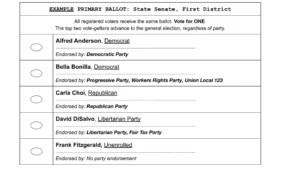
The Benefits of Fusion Voting in All-Party Primaries
More information for voters. All-Party Primaries are likely to include multiple candidates from the same major party. Ballot-visible endorsements tell voters about each candidate’s supporters.
Voters can see a candidate’s labor or grassroots support right on the ballot.
A level playing field. Fusion lets organizations reach voters without costly advertising. An endorsement works like a free mailer. Voters see the organization’s support directly on the ballot. The organization pays nothing.
A role for smaller organizations. A political designation can support a candidate. Unions, community groups and issue organizations gain a visible role in electoral coalitions.
Less vote-splitting. California uses All-Party Primaries without fusion voting. California voters get few cues to distinguish same-party candidates. That fuels fears of vote splitting. Fusion mitigates this problem. Voters have a high-information ballot and can see which candidate commands the support of organizations they trust.
An outsized benefit for trusted groups. Voters respond most strongly to endorsements from groups they recognize. Local organizations with strong community trust benefit most.
Key Rules
- How are political designation names regulated? A designation name may contain up to three words. The name may not include the word “Independent.” The name may not use words claimed by current major parties. The Secretary of State makes sure designation names are not misleading.
- How do major and minor parties make endorsements? Question 3 leaves the current process in place for political designations. A designation’s general or executive committee makes its endorsements. The major parties set their own endorsement rules.
- Can nonprofits participate? Political-designation status is separate from federal tax status. Any group of 50 registered voters can create a designation, and make the endorsement. A 501(c)(3) organization itself may not endorse candidates, but individuals affiliated with a 501(c)(3) may create a separate political designation. They need a separate entity to raise or spend money in elections. However, they do not need such an entity if they spend no money on forming their designation and choosing a candidate to endorse.
- Do candidates have a say in endorsements? Yes. The joint-filing requirement makes sure endorsements only appear with the candidate’s consent.