
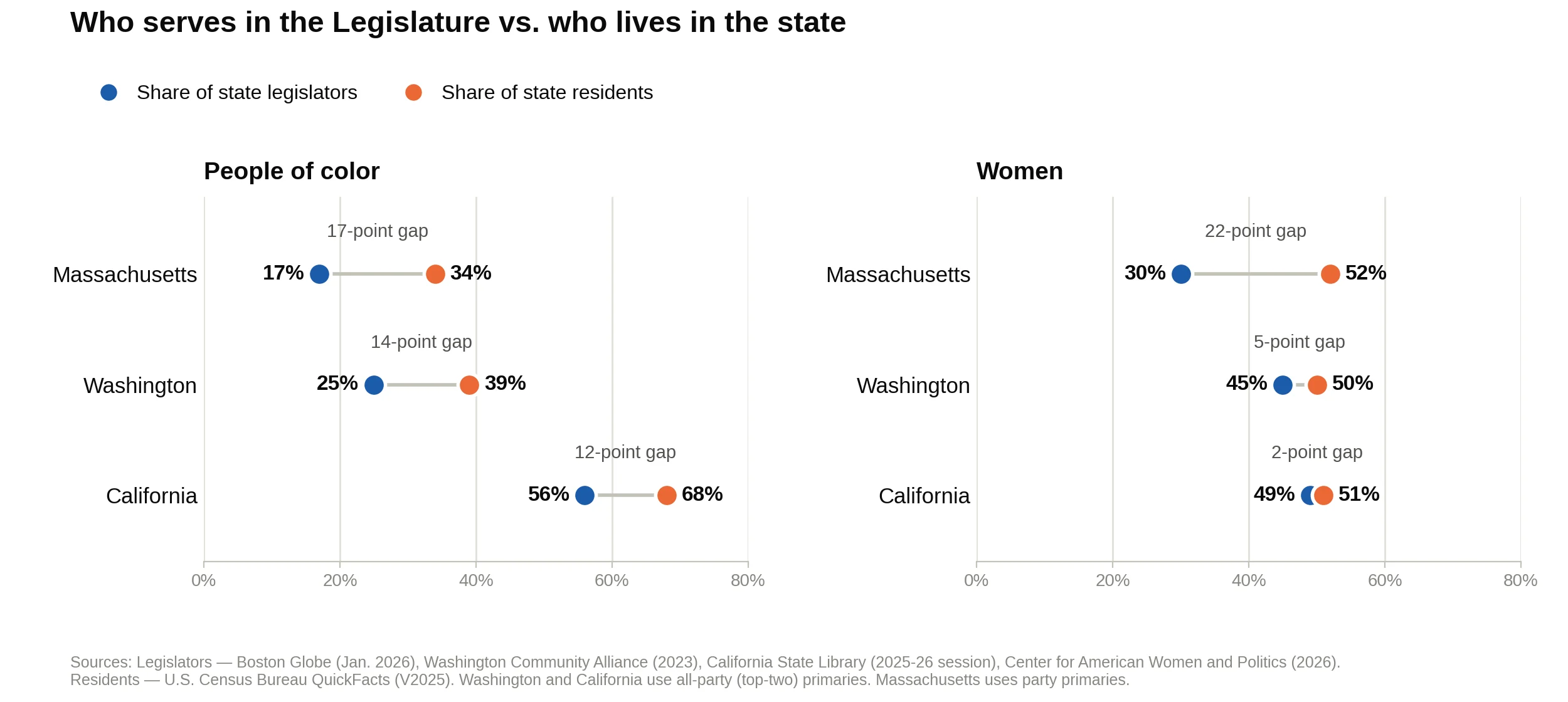
In Massachusetts, one out of every three residents is a person of color, and women make up half the population.
Our legislature, however, is a different picture.
People of color make up 34% of Massachusetts, but only 17% of the legislature. Women are 52% of the state, yet just 30% of the legislature — ranking Massachusetts as 33rd in the country for women’s representation. The body itself is 83% white.
Put all of those numbers together and you get this: white men are roughly a third of Massachusetts residents, yet 61% of the legislature. Women of color are 17% of residents, but less than 8% of legislators.
The Legislature has grown more diverse in the past few years, and that’s real progress. But most of it came in a single election cycle, right after a once-a-decade redistricting opened up seats. Progress that depends on redrawing the map comes only once a decade.
Why it stays this way
Most seats on Beacon Hill are decided before voters ever weigh in.
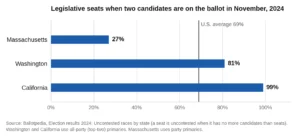
In 2024, only 54 of the 200 legislative seats — 27% — had more than one candidate on the general election ballot in November. Ballotpedia ranked Massachusetts dead last in the country for competitive legislative elections.
When there is a contest, it usually happens in a September party primary, not in November. This year, 90% of the legislative primaries had only one candidate on the ballot. Just one in five voters turns out for a state primary — compared to one in two, and sometimes more, in November.
The result: by the time most voters vote, most of their decisions have already been made.
In other words: Fewer contests. Fewer open seats. Fewer opportunities for new candidates to throw their hat in the ring. The smallest group of voters deciding who represents all of us. The Boston Globe reached the same conclusion: the largest obstacles to a more representative Legislature are “the least competitive elections in the country, meaning incumbents often face few, if any, challengers,” and that “opportunities to run for an open seat are rare.”
We think All-Party Primaries can help solve that. Here’s why:
States with all-party primaries look different
Washington and California use all-party primaries. Every voter gets the same ballot, with every candidate for every race. The top two vote-getters advance to November, no matter their party.
Their legislatures better resemble their people.
| Massachusetts | Washington | California | |
|---|---|---|---|
| People of color: share of residents | 34% | 39% | 68% |
| People of color: share of legislators | 17% | 25% | 56% |
| Gap (bigger is worse) | 17 points | 14 points | 12 points |
| Women: share of residents | 52% | 50% | 51% |
| Women: share of legislators | 30% | 45% | 49% |
| Gap (bigger is worse) | 22 points | 5 points | 2 points |
| Seats with two candidates competing in November, 2024 | 27% | 81% | 99% |
| Open seats, 2024 | 10% | 21% | 34% |
Sources: U.S. Census Bureau · The Boston Globe · Center for American Women and Politics · Washington Community Alliance · California State Library · Ballotpedia (contested seats, open seats). Full citations below.
People of color are underrepresented in the Massachusetts legislature by about half. Washington and California come much closer to a proper representation. California’s numbers are shaped in part by term limits, but Washington’s aren’t — and it still outperforms Massachusetts. For women, Washington and California sit within a few points of parity. Massachusetts is 22 points short.
California’s legislature has set records for both women and people of color in office. In 2012, before its first all-party primary, women held 28 percent of the seats. Today they hold 49 percent.
Their elections are contested, too. In 2024, 81% of Washington’s legislative seats and 99% of California’s had two or more candidates on the November ballot. In Massachusetts? A mere 27%.
Why the difference?
Two things change when the top two vote getters go on to the general election in November.
More people run. In Massachusetts, a challenger who takes on an incumbent from their own party has to win a low-turnout September primary or go home. Under all-party primaries, finishing second in the primary still gets you to November, when there is a larger, more representative electorate deciding. That changes the calculation significantly for new candidates and fresh voices, making running much more worth it. In 2024, Massachusetts had 279 candidates for 200 legislative seats. Washington had 283 candidates for 123 seats. California (which has term limits) had 328 for 100. Research on California and Washington finds that since the switch to all-party primaries, incumbents are significantly more likely to face a serious challenger from their own party. The old party primary format didn’t produce that.
More voters decide. If two candidates from the same party meet in November, every voter in the district gets to choose between them — including the two-thirds of Massachusetts voters who aren’t enrolled in either party. Candidates can’t win by turning out just a small, unrepresentative slice of party faithful alone. They have to knock on every possible door, build new, broad coalitions, and actually make their case on the issues and who they are — not just rely on a party label.
That is how new voices get in: more candidates, more contests, and more of us deciding.
What Question 3 does
Question 3 brings all-party primaries to Massachusetts. One primary ballot with every candidate on it. Every voter can vote. The top two go to November.
That means the election isn’t over in September, when one in five voters shows up. It’s decided in November, when turnout is much higher.
That means candidates have to earn votes from everyone, not just from the political insiders.
That means more contested races, more open doors, and more chances for new voices to win.
A legislature that looks like Massachusetts starts with elections where everyone gets a say.
Vote YES on Question 3.
Read more about how Question 3 will help communities of color.
Sources
- Matt Stout, “Lawmakers of color have grown their ranks on Beacon Hill, but the Legislature remains disproportionately white,” The Boston Globe, Jan. 4, 2026.
- U.S. Census Bureau, QuickFacts: Massachusetts, Washington, California, United States, Vintage 2025.
- Center for American Women and Politics, Rutgers University, state fact sheets: Massachusetts, Washington, California.
- Noah Risley, “The legislature is an ‘old boy’s club.’ How bad is it really?,” Act on Mass, June 27, 2026.
- Ballotpedia, “Annual State Legislative Competitiveness Report: Vol. 14, 2024.”
- Massachusetts Secretary of the Commonwealth, certified candidate lists for the Sept. 1, 2026 Democratic and Republican state primaries.
- Massachusetts Secretary of the Commonwealth, Voter Turnout Statistics.
- Washington Community Alliance, Washington Elected Officials Demographics Project (March 2023), as reported by the South Seattle Emerald.
- California State Library, California Research Bureau, “Demographics in the California Legislature,” 2025-26 session update.
- Sameea Kamal, “The California Legislature set a record for women in office and could see historic gender parity,” CalMatters, Nov. 8, 2024.
- Jadenne Radoc Cabahug, “The Washington state Legislature is more diverse than ever,” Cascade PBS, Nov. 26, 2024.
- Ballotpedia, “Election results, 2024: Uncontested races by state.”
- Ballotpedia, 2024 state legislative election results: Massachusetts, Washington, California.
- Steven W. Sparks, “Quality challenger emergence under the top-two primary: Comparing one-party and two-party general election contests,” Electoral Studies, 2020.
- Massachusetts Secretary of the Commonwealth, Registration Statistics, September 2026.
- National Conference of State Legislatures, “The Term-Limited States.”