Both major political parties have decided to oppose Question 3 because it gives power to voters, not insiders. But Massachusetts voters are used to seeing through myths and political doublespeak. Here’s the opposition, in their own words — followed by what is actually true.
Myth: “What it reliably does is make the early, low-turnout primary the decisive race.”

Fact: Question 3 does the opposite. It moves the real decision to November.
Today, the September primary is the decisive race for most elections. This year, 155 of 200 legislative seats were decided in the primary. The winner faces no Republican or Democratic opponent in November. That’s more than three out of four.
And the September primary is where only one voter in five shows up.
That’s one reason why we have the least competitive elections in the nation.
Question 3 makes the general election the decisive election by sending the top two vote-getters to November, when about one voter in two shows up. That way, the general election, when most people vote, becomes what decides who represents us.
Even the opposition agrees: Under Question 3, “I do not dispute that the general election might be more decisive, but I don’t necessarily see that as a positive,” said one of the groups opposed to Question 3.
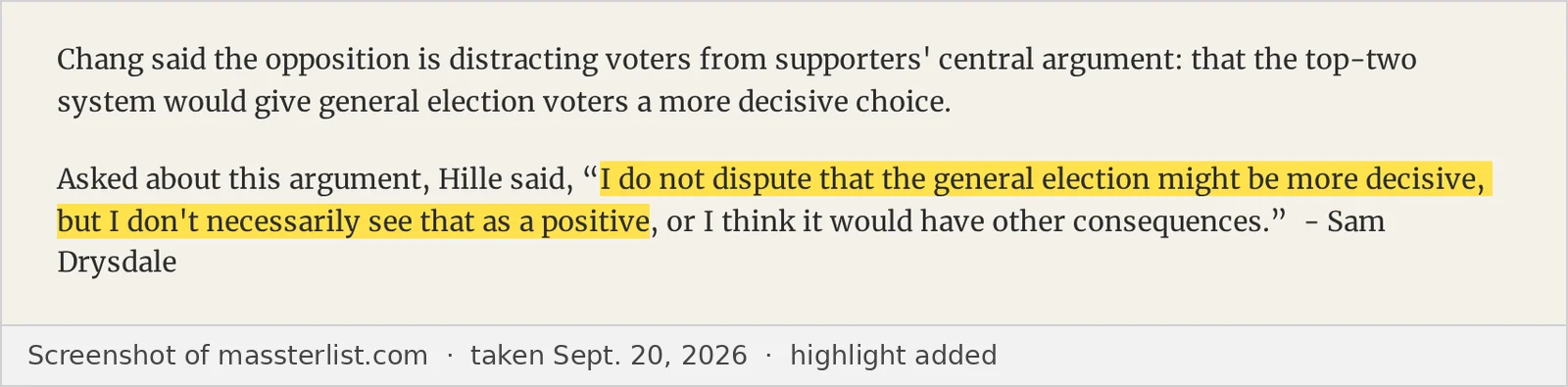
We do. That’s the whole point.
Myth: “Fewer names in November is not more democracy.”

Fact: Fewer than what? Today, most November ballots have one name.
This year, 155 of 200 Massachusetts legislative races were settled in September. The winner has no Republican or Democratic opponent in November. All but a handful of those ballots will have one name. Ballotpedia ranks Massachusetts the least competitive state in the country.
Under Question 3, any race with two candidates goes to November. Two names is not fewer than one.
The No campaign website says the field of candidates should be widest in November, “when turnout is highest.” It sure seems like they agree with us — but they are defending keeping our primaries small, limited, and decisive.
Myth: “If you’re unenrolled, you can walk into your polling place on primary day and choose either party’s primary ballot. You are not locked out of anything.”

Fact: You can pick one party’s ballot, but it might not include every contested race. And currently, most races in Massachusetts are uncompetitive, meaning there’s only one candidate to “choose” from.
Two out of three Massachusetts voters are unenrolled. In every county, unenrolled voters are the majority.
This September, there were 400 possible legislative party primaries. Only 42 had more than one candidate. That’s 90% with no contest at all.
Of those 42, 32 produced a winner with no Republican or Democratic opponent in November. Their seats were decided in September.
You can walk in. The door is open. The room is empty.
Question 3 puts every candidate on one ballot, and sends the top two to November. Every voter gets a say in the election that counts.
Myth: “It just strips away information voters use.”

Fact: This reform provides a high-information ballot, designed specifically for Massachusetts. Your ballot will show each candidate’s party, along with party endorsements.
Question 3 prints each candidate’s party next to their name. It also lets a party — major or minor — put “Endorsed by” on the ballot next to its candidate, with the candidate’s consent. Those are important cues for voters.
That’s more information than a primary ballot gives you today, not less.
Myth: Question 3 was “written and paid for by a small group of investors which will allow other billionaires to buy more elections in MA.”
— No on 3 campaign presentation, Sept. 15, 2026

Fact: Question 3 was written in Massachusetts, by democracy advocates. And in reality, under top-two elections, money does not become more powerful. In fact, it buys much less than it used to.
Who wrote Question 3? Danielle Allen and the Coalition for Healthy Democracy team. Read the full story.
Big money doesn’t win more under All-Party Primaries. An analysis of 13,400 races and their campaign-finance records before and after top-two reform in California and Washington, shows that money did not become more powerful under top-two, or all-party primaries — it “buys” less than it used to. And winning didn’t get more expensive — the median winning California statewide campaign actually fell, from $5.7 million to $3.0 million. The real system that big money loves is unchecked incumbency, perpetuating a system where incumbents win by default, without any competitors.
The funders of Question 3 are public record, and it should be noted that many of these donors have also supported other good-government reforms like Ranked Choice Voting, the Fair Share Amendment, and many more. And let’s be clear: Massachusetts has some of the strongest campaign finance limits in the United States, capping contributions at $1,000 a year and banning direct corporate contributions to candidates. Question 3 changes none of that.
Here’s what the No campaign’s own website says: “Big money goes further when the real race is settled in a crowded primary.” That’s accurate. And it’s an argument against the system we have now, where the real race is settled in September by one voter in five.
Question 3 makes the deciding election bigger, not smaller. A candidate with a big money lead won 92% of races under party primaries and about 77% under all-party primaries. Bigger electorates are harder to buy.
The opposition’s own example proves it. Their FAQ says that in California this year, “third place was a self funded billionaire.” He spent more than $200 million and didn’t make the November ballot. In Wisconsin last year, Elon Musk and his allies put more than $20 million into a nonpartisan election open to every voter. Their candidate lost by 10 points.
Myth: “It shuts out independents and small parties.”

Fact: No, it empowers them. Small parties get something they don’t have today: their name on a primary ballot that all voters will see.
Under Question 3, an independent or minor-party candidate runs in the same September primary as everyone else. Finish in the top two, and you’re on the November ballot with a real shot, not as a protest vote. This is real leverage and visibility, putting them on equal footing with major parties.
A minor party can also put its endorsement on the ballot — even next to a candidate from another party. Today it can’t.
Myth: “Question 3 didn’t grow out of Massachusetts.”

Fact: It did. This campaign is Massachusetts-grown and Massachusetts-funded.
Question 3 was founded and organized by a Massachusetts ballot committee, consisting of Massachusetts residents, with 120,000 Massachusetts voters from across the Commonwealth signing their name to get all-party primaries on the ballot.
And importantly, this is how Boston and other municipalities across Massachusetts pick their mayors and municipal officials, with an all-candidate preliminary that sends the top two to the final. It’s a familiar system that already thrives here.
Read more about how we got started and view our endorsements.
Myth: “There is no credible report or study that indicates that Top-Two or All-Party Primary elections increase turnout, with reports showing a potential correlative but not causal effect.”

Fact: States with all-party primaries have higher turnout — a peer-reviewed study of two million voter records found it in every age group and every income group. The biggest gains were among young voters. You can read the research on our research page.
We all agree increasing turnout is good — because with more people voting, they get their voice heard. Which is also why moving the decisive election to the general election matters.
Here is how the Center for State Policy Analysis at Tufts, a neutral source, describes Question 3: “Today, the two most popular candidates often square off in a party primary, when turnout is lower and less representative. Under Question 3, they could meet on election day, when turnout and interest are peaking.”
About one in five Massachusetts voters show up in September. About one in two show up in November. Question 3 moves the decision to the election where more than twice as many people vote.
They say: “November’s election can be two people from the same party.”

Fact: Today’s November ballot usually has one person, from one party.
Two candidates from the same party reach November in districts where that party has most of the votes. There, voters get a real choice between two people, instead of a formality.
The case people worry about — a district’s majority shut out of November — has happened three times in more than 2,000 all-party primary elections in California and Washington.
Compare that to Massachusetts today, where three out of four legislative races give you one candidate in November. Not two from the same party. One.
And under Question 3, parties can put their endorsement right on the ballot. Voters will know who the party backs.
The question they won’t answer
Two out of three Massachusetts voters are unenrolled. Most legislative seats are decided in a September primary where you can vote in only one party’s contest. Most of those contests have one candidate.
Who should decide who represents those voters? Everyone, in November? Or the few who show up to one party’s primary in September?
We say: everyone in November.
That’s Question 3.
Vote Yes on 3 on November 3. And request a free lawn sign so your neighbors know it’s on the ballot.